
I am deeply grateful for your kind introduction.
Mr. Gustavo Petro, President of the Columbia University
Distinguished Professors,
Esteemed Members of the Faculty,
Dear Students,
Ladies and Gentlemen,
It is with the deepest sense of humility and gratitude that I address this esteemed gathering today. To be standing here, in one of the world's finest institutions of learning, is a moment of profound privilege.
I extend my heartfelt thanks to you, Mr. President, for this gracious invitation.
In our Nepali culture, we regard places of learning as temples of wisdom, and I feel as though I am standing in one of the grandest temples of all.
Today, I wish to speak about my country Nepal’s journey to democracy and economic prosperity - a journey that has been filled with trials, triumphs, and the indomitable spirit of a courageous people who have fought tirelessly for their rights as citizens.
Nepal’s journey to democracy is a tale of resilience, one that spans over seven long decades of struggle, sacrifice, and persistent hope.
A Nation Steeped in History
Nepal, nestled in the lap of the majestic Himalayas, is a country that boasts a history as ancient as time itself. The roots of our civilisation stretch back over five millennia, to a time when sages and seers got enlightened on our land, and when Buddha was born in Lumbini, and his teachings spread a message of peace and compassion to the world.
While our past is steeped in the spiritual and cultural treasure, the modern history of Nepal begins in the year 1768, when our ancestors under the leadership of the then King Prithvi Narayan Shah unified a series of small, fragmented principalities into a single nation. This was a monumental moment, marking the foundation of modern Nepal.
It is a coincidence of history that this unification occurred around the same time the United States of America adopted its Declaration of Independence.The two great struggles of nationhood were taking place at the same time of human history, yet they were oceans apart geographically.
For Nepal, the road to modernity and democracy was not a straight path. While our ancestors valiantly defended our sovereignty during the Anglo-Nepali War of 1814-1816, the internal strife in the Royal Court that followed led to the rise of the Rana oligarchy in 1846, an oligarchy that would rule Nepal for over a century. Under the Ranas, Nepal was isolated from the rest of the world, kept in the dark, and deprived of education and progress.
For 104 years under the Rana oligarchy, the people of Nepal endured the tyranny of an authoritarian regime that suppressed their freedoms and stifled their potential.
The First Dawn of Democracy
The year 1951 marked a turning point in Nepal’s history. After years of struggle, the Rana oligarchy was overthrown, and Nepal took its first steps towards democracy. The dawn of democracy had arrived, and with it came the promise of a brighter future for the people of Nepal.
Yet, the euphoria of those early years was short-lived. The king soon nipped the democracy in bud imposing a party-less system of governance known as ‘Panchayat system’. This system, which lasted from 1960 to 1990, prohibited political parties from the politics.
Despite these setbacks, the flame of democracy was never fully extinguished in Nepal.
The People’s Movements and the Triumph of Democracy
The flame of democracy flickered once more in 1990, ignited by a massive popular movement known as the ‘Jana Andolan’ or People’s Movement. This movement was led by a coalition of two competing ideological trends—those from the Centre to the Left and those from the Centre to the Right.
The indomitable spirit of Nepali people compelled the absolute monarchy to yield to demand for a democratic constitution.
The Constitution of 1990 established Nepal as a constitutional monarchy with a multi-party democratic system and enshrined fundamental rights such as freedom of speech, assembly, and association. This pivotal change restored a 'representative' democracy.
Despite the system's gradual progress, new challenges soon emerged before democracy has taken its root in the country. In 1996, an armed violence led by the Communist Party of Nepal (Maoist) plunged the country into a decade-long voilent conflict. This conflict, which aimed to topple the government and capture the power, resulted in the tragic loss of over 17,000 lives and further destabilised the nation.
After the turn of the millennium, king once again seized power on the pretext of insecurity thanks to the Maoist violence.
In 2006, again, a wave of democracy swept over the shore of Nepali politics as mass uprising known as yet another ‘Jana Andolan’ or People’s Movement –forced the monarchy to relinquish its power. It led to the signing of a Comprehensive Peace Accord in November 2006, ending the Maoist conflict and bringing back the country to peace and democracy.
In 2008, for the first time in our history, a Constituent Assembly was elected. The very first meeting of the Constituent Assembly took a historic decision to abolish the monarchy, ending the 240-year reign of the Shah Dynasty and transforming Nepal from autocratic kingdom into a Democratic Republic.
This momentous achievement highlighted the power of the people to shape their own destiny. The long and difficult struggle for political freedom had finally borne fruit.
The Promulgation of the Constitution and the Road Ahead
The journey towards a fully functioning democracy, however, was not without its challenges. The first Constituent Assembly expired its term without writing constitution. In 2013, second Constituent Assembly was elected. Almost after 8 years of debate, discussion, compromise and negotiation, the new Constitution of Nepal was finally promulgated on 20th September 2015, the 7th constitution in our history – of course the most progressive one.
The Constitution of 2015 represents the culmination of Nepali people’s seven decades political struggle and sacrifice. It has provided a stable legal foundation, allowing us to focus on the next phase of our national journey: the pursuit of economic prosperity.
Ladies and gentlemen,
We still have to resolve one protracted issue from the conflict era. That is the issue of transitional justice. But we are determined to settle it once and for all as immediately after the formation of my government, our parliament enacted a revised consensus bill in this regard recently.
We see democracy as a political and social system in which every people feel dignified, every people see boundless potentials, every people feel safe and secured.
Democratic governance system is based on civic responsibility and discipline. Without discipline, democracy risks devolving into mobocracy, a state of anarchy that threatens peace and stability.
Freedom, when divorced from civic responsibility and civilised behaviour, cannot be deemed democracy.
My lifelong commitment to democracy has shaped a vision and conviction which I call ‘comprehensive democracy’. Comprehensive democracy extends beyond the mere right of the people to choose their leaders. It encompasses a deeper and broader aspiration: the creation of a stable, peaceful, harmonious, egalitarian, and prosperous political community.
Comprehensive democracy involves generating wealth in harmony with nature and equitably distributing it to build a just, peaceful, and prosperous society. Creating wealth at the expense of nature or through the exploitation of the underprivileged to enrich a few cannot be considered democracy. Instead, such practices morally and ethically undermine democracy.
My envisioning of comprehensive democracy is about cultivating an environment that guarantees equal rights, equal access to opportunities, social justice, and security as well as dignity for all. It aims to elevate human conscience and advance civilisation to a higher realm.
With this conviction, we have built our constitutional framework upon the twin pillars of political liberalism and socialist orientation. Our goal is to ensure that economic advancement benefits all citizens, thereby realising the true potential of comprehensive democracy.
In the history of human civilizations, politics and political parties have evolved as indispensable means to manage a large and complex society in an orderly manner. In the context of Nepal, political parties were not recognized as such in the large part of Nepali history.
Now, what I can say is that political landscape in Nepal has changed. People are aware of necessity of political parties through which they express and exercise their sovereign rights as the direct democracy is not pragmatic in today’s large and complex society. Our constitution guarantees these rights as irrevocable.
Nepal’s Economic Transformation
Now, let me touch upon our journey of economic development.
As early as the mid-17th century, Nepal thrived as a vibrant entrepôt between India and China. Trade between these two great nations was routed through Kathmandu, and so much so that Nepal enjoyed the lucrative privilege of minting silver coins for Tibet, a highly profitable enterprise.
However, after the establishment of modern Nepal in 1768, the nation was embroiled in continuous wars for expansion and consolidation for several decades, leaving little room to focus on economic development.
In the meanwhile, the rise of the Rana oligarchy in 1846 further stifled the potential of economic progress as the Rans regime wanted to keep the people in darkness to prolong their family rule. Under their rule, education and innovation were prohibited.
The journey towards economic prosperity has been as challenging as our political struggle.
For much of the 20th century, Nepal’s economy was largely feudal and agrarian with widespread poverty. However, over the past few decades, we have made substantial strides in improving the socio-economic conditions of our people.
In 1960, only 6% of Nepalis had access to piped drinking water. Today, that figure stands at 93%. The infant mortality rate has fallen dramatically, from nearly 200 per 1,000 live births in the 1960s to 21 per 1,000 live births today. The adult literacy rate, which was around 10% in 1960, has risen to 77%. These improvements reflect the progress we have made in key areas such as health, education, and access to basic services.
These statistics tell a story of progress, but they are far from enough. We need to do more. We need to gear up.
As we look to the future, our national aspiration remains clear: Prosperous Nepal, Happy Nepali. This vision aims to create a society where poverty is eradicated, all are benefitted from development and every individual lives with dignity and hope.
Despite numerous obstacles, we are steadfast in our determination to accelerate our economic transformation and to graduate from the Least Developed Country category by 2026. Our focus remains on achieving the Sustainable Development Goals within the designated timeframe and marching towards becoming a high-income country by 2043.
Mr President,
Nepal is not destined for economic backwardness. On the contrary, I hold a profound conviction in Nepal’s potential for enduring prosperity, which we can achieve within a relatively short span of time.
We are a vibrant democracy with a stock of hard-working young population who possess an open and receptive attitude. Nestled between India and China—both of whom have become economic powerhouses—Nepal is uniquely positioned to make its economy dynamic for accelerated economic growth.
We are determined to turn our ‘landlockedness’ into ‘landlinkedness’ by connecting our economy with two giant global economic powerhouses located in our adjacent neighbourhoods.
Our country is blessed with breathtaking natural beauty, abundant resources, and a rich cultural heritage. We also have significant potential in hydropower generation. There is no reason why we should not harness these strengths and realise our national aspiration of a "Prosperous Nepal, Happy Nepali."
Our people undoubtedly deserve a better and happier life. With this urgency in mind, I am now leading a government formed by two major political parties in parliament, which have played decisive role in the journey towards democracy and nation-building.
Our two parties are committed to providing exemplary governance, with a resolve to set a standard of integrity and transparency. We will ensure stability and policy consistency, leaving no stone unturned to create an investment-friendly environment that attracts both domestic and foreign investment.
Nothing is more paramount to us than to bring the prosperity and happiness in the lives of our fellow Nepalis.
In our quest for national development, we call upon our development partners to enhance their support, and we also value the contributions of the Nepali diaspora through investment and expertise in their fields.
Our two parties aim not only to beat a usual political path but to expand it into a broad highway for rapid economic advancement.
While being fully aware of a formidable path ahead, I am resolute in my determination to propel Nepal into a realm of sustained economic prosperity.
Thank you all.
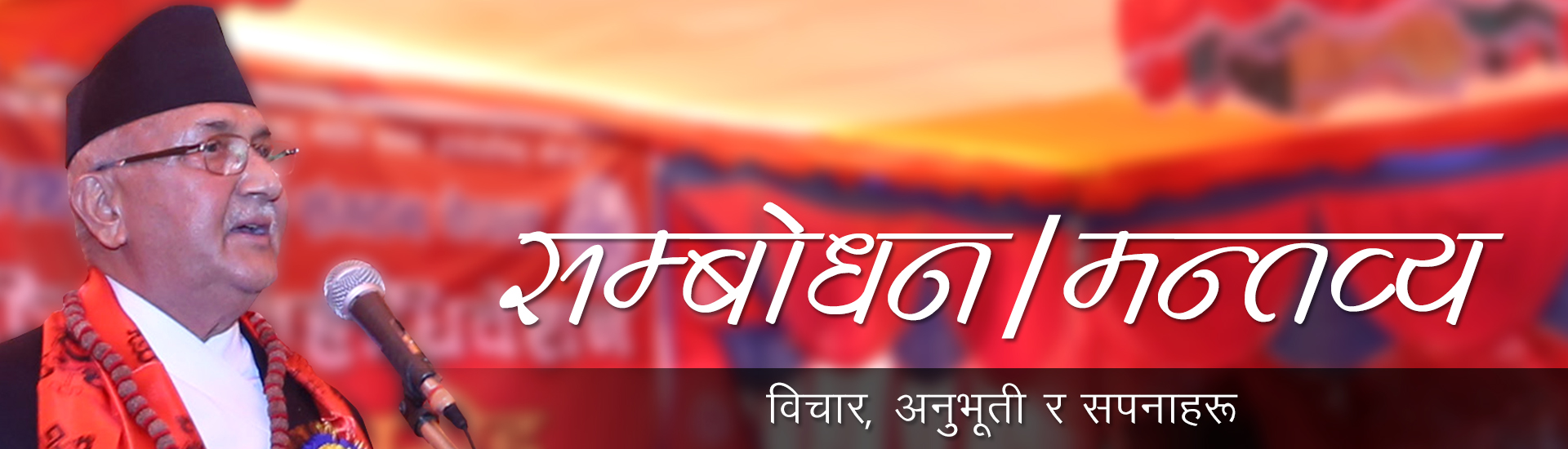
[Keynote Address by the Right Honourable Mr. K P Sharma Oli, Prime Minister of Nepal, Columbia University, New York; 25th September 2024]